Friday, October 2

On Facebook

My relationship with my parents has been slow. I missed a lot of the stereotypical milestones: I didn't rebel in my teenage years, and wasn't embarrassed or estranged from them in my twenties. I've always respected them, and while some of the things they believe are strange, they put a high value on being honest with me and instilling in me a love of the pursuit of truth.

So things have been kinda chill... until Facebook. More specifically, about the time they (and one of my grandpas?) started using it to "like" things that were tritely religious, vaguely racist, and/or misinformed/misleading. Particularly bad were the bits that were religious on the surface, but smacked of a weird blend of triumphalism, conservative talking points, and urban legends.

Now, I know, posts like that are very common on Facebook. But it's been really disheartening to witness my own parents'... descent(?) into the illness that is "viral theology". 

Thursday, February 5

on Getting By

My dirty little secret is that I make enough money. We keep our bills paid and go out occasionally. We break even, usually, but have not really been able to save, and the idea of retiring is kinda laughable. We have no kids, but I'm not sure we could, and I have no idea how parents who make less get by. I'm well aware that many kinda don't. It's also very unsurprising to me that many in my generation or a little younger still live at home, despite having near-full-time jobs and being measurably more productive than workers 30 years ago.

All this to say, referring to a figure less than half of what I make as a "living wage" seems wrong. Globalization has lifted many out of poverty, which is great, and that flattening has meant the affluent US stagnates a bit. I do not resent that at all. But of course that's not where most of the wealth has been going.

So what's my point? Don't stigmatize things Millennials do to be thrifty - they are generally more responsible with money than GenX. Raise wages, not dividends - shareholders get theirs AFTER the company covers its responsibilities. Raise taxes on people making as much as I do or more - trickle-down has been proven to not be a thing that happens. Be personally generous, but recognize that people who work should not have to also be relying on charity or EBT - being under-employed is a real thing, and if you don't think being underpaid is a real thing, well, you may be part of the problem.

Friday, January 30

On Getting Things Backwards

I used to be bad at sex. Not that I didn't have the anatomy down in theory, or that I couldn't perform, but I had very backwards ideas about it that kinda ruined it. Basically, what I'm saying is that I was probably a typical raised-Christian teenager. I was wracked with guilt over the desires I had and the ways I acted out when feeling sexually frustrated. And while of course none of my romantic relationships explicitly allowed for physical intimacy, boy did we ever. I always felt bad afterwards--kinda.

So I admit I regret the times I had premarital sex... but not for the reasons one might think.


1) I regret that we never talked about it beforehand. Encounters were consensual, but if you'd asked us on our better days about our relationship boundaries, you'd probably have gotten an answer like "we kiss, but not with tongue" or somesuch. We never discussed with each other where our boundaries really were, or what felt good, or what we were curious about. We let our hormones lead, fumbled around a bit, and took advantage of what chances we got to explore. The illicitness was exciting, of course, but very unsatisfying, and we both dreaded that time afterward when we'd inevitably have to apologize and walk back everything we'd just done.

2) We never got to enjoy each other. We took a long time to work up to sex, but only because we were inching up to the pre-established line and then just a tiny bit over... and then each waiting to see if the other person would call us on it and end things for the day. Sometimes that did happen, if you'd believe that of a couple twenty-year-olds. But this slow boundary-creep meant no relaxation during intimacy, no easygoing "hey, why don't we just hang out naked?" No rose petals, no showering together, nothing that might be an obvious sign that, rather than just unstoppable hormones, our intimacy was premeditated.

3) As such, we were never responsible about sex. Even when condoms were free down the hall outside the dorm RA's room, we never picked one up. We were Christians, and supposed to be a good example - what if someone saw us take a condom? The completely backwards logic in that line of thinking had not occurred to us. The same applied to other birth control, too - we weren't supposed to be having sex, it's immoral, so why would she go and get on the Pill? So... we took our chances, very stupidly. We were lucky, but stupid. I'm wanting to say "stupid" several more times here.

4) I regret what it did to the relationship. It's not that I think the sex was wrong, though it was a very bad idea considering my immaturity about it at the time, as the above illustrate. And setting boundaries is good, but a relationship built on crossing them is not going to be healthy. So we ended up with zero trust (of each other or ourselves), lots of guilt, and, since we were both mainly just in it to see how much we could get away with, no long-term plans or security.

5) And I regret how we saw the intimacy relating to our spiritual lives. We were constantly in a state of thinking God was mad at us, and it kept us spiritually stunted to always be lying to ourselves and others. I am still Christian, but I'm much more aware now of concepts like "consent" and "having responsible sex," and I no longer think "sex before marriage" is even all that sinful. We are not to be slaves to our passion... but when I think about it now, my early fumbling was a time when I was not free. We had no control, or thought we didn't, or at least told ourselves that we didn't in order to assuage our consciences whenever we crossed the lines. Whereas if we'd been able to talk and explore and enjoy things in a more measured fashion, we would have been showing some control over our passion.

It's likely that many Christian college kids find themselves in the same situation as I was, where the cycle of repression/transgression repeats every couple days or weeks. I sometimes wonder whether my past will turn out to be useful to others, if only in a cautionary way, and this is one area that always comes to mind, even though it is very difficult for me to talk about and taboo in most Christian circles. I wonder what someone could have said to me, back then, to help change my state of mind. I'm not sure.

As it was, it took a ridiculously bad breakup, depression, then years of learning to accept myself. And I learned, too, that not all Christians see God as a sin-tallying rules-lawyer when it comes to sex. Sex is important, but it's not the be-all and end-all of holiness. And shame over our bodies is disrespecting the image of God.

I should definitely add that years of being happily married have helped, also. Not that I am a fan of marriage for its own sake, but finding someone I could be myself with, be human and fallible with, has made marriage amazing. I'm well aware it's not the same for everybody.


Today, I am sex-positive, an ally of people who don't share my orientation, and generally very liberal and permissive. The regrets I've listed derive from this liberal perspective, somewhat ironically - I was irresponsible, did not get enthusiastic consent, lied to myself and others, and managed to do it all while ostensibly condemning as immoral the behavior of my peers. Eesh. Thankfully, God has been far more chill than I had imagined possible, and hopefully what I have gained from all this is a modicum of wisdom. That hope, and the hope of maybe using it to save some other poor soul some inner trauma, easily overcome these regrets.

Thursday, August 21

On Sacrifice

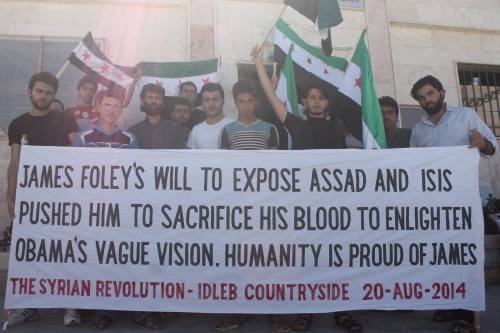
It's been a couple days since photojournalist James Foley was killed. I usually don't have much to add except my simple sympathies when this sort of thing happens; he seemed like a great guy, but I didn't know him personally or anything like that, and I always worry about "politicizing" it more than perhaps respect would warrant.

But comments I saw out on the internet a few times got me thinking: the comment was, "That could have been any one of us." And this is just so wrong and disrespectful that I feel I need to vent a little.

It's an okay sentiment at best, one of solidarity with the family, but it entirely discounts that James Foley was badass. And not like katana-wielding-badass: he shot things only with his camera, and his curiosity and bravery going into war-zones armed only in that manner amaze me. I have not done anything like that in my life, to be sure, and I admire him for his conviction and caring. He cared for the peoples' stories, and made friends even among his captors. Truly badass.


But the people commenting "it could have been us" aren't even other journalists, mostly (and I'm not referring to the ones who use the phrase in that manner). The people I saw commenting were... white American Christians. And that was the "us" they meant. James fit this broad category (as do I, it's that broad), as he was a Catholic whose faith motivated him deeply... but that's not all that's required to find oneself killed by ISIL. No, for that, American Christians might have to get off their butts and care about what was going on halfway around the world. They might have to be able to interact respectfully with other cultures and religions and take an approach other than advocating carpet-bombing cities ISIL currently controls. It would require a sense of daring beyond what I possess, for sure.


The goal with the comment, then, was basically trying to take ownership of what is not theirs. It is in the context of making jingoist, hawk-ish statements about what our military response should be. It is in the context of trying to paint all Muslims as ISIL minions, and obscuring the (many, many) other people of non-Christian faiths that ISIL has also killed, not to mention all the civilians in those cities who've found themselves suddenly behind enemy lines. This is why I said it disrespects Mr. Foley, and why I believe it is an unChristian sentiment, somewhat ironically - it is tribalist, it is stuck on violence, and it tries to take from his sacrifice and pretend like the speaker would be as brave or noble in death as he was. The difference is that Foley was brave and noble in life, as well, and lived out his faith by going and doing and caring. Let us aspire to that, for ourselves, and take risks to learn other people's stories. Otherwise we're further from being James and closer to being ISIL, just with different hats, killing indiscriminately due to ethnicity or nationality or assumed religious affiliation, and perpetuating a bloodthirsty religious feud.

Friday, July 25

On fandoms and Christianity

So it may be surprising to hear but I'm not really a fan of anything. Not to say that I don't like things - shows, sports, bands, etc. - because I do. But I don't really go out of my way to get or wear merch of any sort; I've never gone to a Con, and even for shows I do like that have pretty strong fans (Firefly, Star Trek) I've never gotten involved with fan sites or those communities.

Why is that? I guess part of me is just very even-keeled - my highest levels of enthusiasm manifest themselves in a pretty tame fashion. It isn't repression; I'm just not that excitable or high-strung.

But a big part of it, also, has to be that fandoms have scared me off a bit. Not to say that all fans are bad, but rather just that I've never felt that liking the same band or show necessarily gives me all that much in common with other fans.

As a case in point: I am sort of a Brony, in that I am a grown man who likes the latest version of My Little Pony. It's a funny show. And at first, I could like it without that feeling that much weirder than just the normal "isn't it silly that that dude likes a girls' show." But the word "Brony" has come to have some crazily bad connotations, thanks to some guys who were into the show for all the wrong and creepy reasons. So now it's hard to say I like the show without, in the back of my mind, thinking, "gosh, I hope my friend doesn't think I mean it like that."

So yeah. Some few fans can ruin things for everybody, which stinks. This isn't a reason not to like those same things, but rather a reason I've had a hard time being gung-ho about joining fandoms. SDCC is going on right now, and it seems like an awesome time - but between my natural inertia and the above sort of disconnect from fan communities, I've just never felt a strong desire to go. Which might be sad in some way, but I don't think of it as a failure to be true to myself or anything like that. It'd be a chance to meet Adam Savage, Wil Wheaton, Felicia Day, or Phil Plait - who are all awesome individuals - but I guess it's still in that area of "it'd be cool to hang out with them but I don't feel a particular need to own a signed photo of them."

In the same way that I'm not afraid to admit I enjoy My Little Pony or OITNB or Star Trek or Boston or Janelle MonĂ¡e or Nostalgia Chick or F1 or Gone Home or Firefly or Tomb Raider, I also still will tell people I think Jesus is cool. The term "Christian" has, rather like "Brony", come to be associated with creepy men and co-opted by people who really do not do a good job embodying the foundational principles involved. It's sad when the original messages of love and kindness, humility and honesty, generosity and... fun(?) don't seem to be passed onto the fans... I'm still talking about Christians, I think? Anyhow.

I try to still use those terms and redeem them a bit, but I'm also careful to do so usually in a context with people who already know me and have some context. Maybe that guardedness is why it's hard for me to be a fired-up "fanboy" but I guess I can only hope people don't mistake my lack of tribal identifiers for a lack of appreciation or love for the source material.

Tuesday, July 22

On fantasy worldbuilding and the end times

Made-up worlds say a lot about their author. When thinking about the setting for a fantasy (or sci-fi) story, be it a novel or game or movie, it's easy to get bogged down by the scope of what one is trying to do: namely, nail down a new universe's-worth of rules, from laws of physics to supernatural entities. 

Is there magic in this new world? A "Force"? Some cosmic battle between good and evil in the backdrop? It's tough to decide. Sometimes a setting leads the course of the story, even. The new Dragon Age games, for instance, have the player fighting demons - and this poses many philosophical and moral questions. (Like how do "Sloth Demons" or "Rage Demons" relate to laziness and anger management in general?) More importantly, it's meant that the stories the series is telling have tended towards the black-and-white. Things are either demon-tainted or not, to the point that the most recent sequel is subtitled "Inquisition". This seems to be a common slippery-slope in this sort of fiction - you may set out to tell a story about palace intrigue or coming-of-age, but if in the backdrop you have demons that can possess people, it's a pretty safe bet that you'll end up with an Inquisition or the like.

As a second example, in a Legend game I've been in recently, we came across a witch. Blood magic, that sort of thing. Needless to say, the group of good-guys ended up killing the witch - but we've been very hesitant to tell the local authorities that there looked like there might be more than one, for fear of starting a witch hunt.

Some stories run with this on purpose: in the Warhammer 40k universe, there is a galaxy-wide Inquisition going on and it is a massive dystopia of constant war against aliens and demons. This is why my personal feeling is that no good stories can be told in 40k: it makes for great table-top miniature gaming but the setting is fixed, unchangeable and hopeless. Perhaps the one realistic part is that there are no "good guys" per se - every faction, including the original Space Marines, have crazy fanaticism and have committed countless atrocities during the fighting.

For contrast, part of what makes Tolkien's original stories great was their side-stepping of these cosmic struggles. Sauron is evil, no doubt, but opposing him is done mainly via virtues and inner strength, and not mere conflict and victory through greater military might, say. Tolkien's villains choose evil, and power, and darkness; they are not inherently demons or even all past the point of redemption. Most importantly, Tolkien's stories start and end in normalcy, which I think is key, but we'll get back to that in a second.

Thus there are two ways to go on this issue when building a world. Black-and-white cosmic struggle, which can, in the end, really only end with a purge. Or, a world with a lot of gray (or a small enough scope), so that villains are still human, and life can go on peacefully on the whole. Some stories are easy to classify, others walk the line a little (though mostly these are merely delaying the inevitable demon-slaying). Some look like one, but are really the other: Star Wars is a gray universe, despite the Light and Dark Sides to the Force. Game of Thrones, conversely, looks gray, and certainly has enough factions, but in the end somebody's going to have to deal with those zombies White Walkers. There's no live-and-let-live there.

So which are you and I living in? You had to know I'd get to that question eventually. And it's a little cheesy to say "both", I know, but I think that's going to have to be my answer. I think there are two factors here which make both sorts of stories resonate with us:
  • We are surrounded only by fellow humans to interact with (other than the general environment and forces of nature). This makes it seem like a very gray and small setting - none of us will ever slay a demon, and the "inquisitions" we have had in the past have been atrocities rather than victories for Good.
  • We also know about Good and Evil, though, and the Christian mythos at least has supernatural entities, and a hope that eventually evil will be banished from our world and only peace and good and love remain forever. This does seem to necessitate an apocalypse of sorts.
The key is in what we humans can actually do to influence and participate in these areas. In a video game or most fantasy settings, swords (and guns, sometimes) can kill demons and dragons and all kinds of evil or mindlessly destructive things. This means that people can participate in the aforementioned apocalypse. But here in the real world, we've only been given power to affect other people. Sure, Christianity has the concept of "spiritual warfare", by which is meant merely prayer and being virtuous - but resisting those sorts of demons is not done with violence. Quite the opposite.

So we're caught in the middle. It'd be easier in some ways if we could interact with the world as in some of these games, where Evil is always incarnate and defeated with a level-appropriate weapon. But no, we're stuck with living honest lives with integrity, loving our neighbors, and even loving our enemies. The apocalypse may yet come, and 2/3 of heaven will vanquish the other third - but a suit of armor or a gun will do you no good at that point. Those stories are fun to read about or play through in a game, but too much real-life violence is motivated by people living in a fantasy world where somehow injuring each other achieves a higher good. This isn't video-games making people violent - this is an age-old tale of people wanting to be the hero in their own story, and dehumanizing others to make it possible.

Thursday, August 8

On News

Journalism is a good thing. I'm just gonna come out and say it up front, since I think "the media" gets a bad rap, and sometimes it's true that they're not doing their jobs as well as they should. But I think that correct criticism of journalists is always pointing in the direction of:


  • You should have researched this more.
  • You shouldn't only choose stories that confirm existing biases of your readers.
  • You should have high standards for your writing.
  • You shouldn't parrot official positions as news, whether of governments or of your owners.


So I'm sure you've noticed the trend, namely that these are all urging journalists to hold more closely to the ideals of journalism, which is why I can call it a "good thing." It is the one case where poking your nose where it's not wanted is actually worthwhile. To want to get to the heart of a matter, and seek truth, is noble. And to speak out when you see cases of corruption, hypocrisy, or just plain callousness on the part of governments or corporations is important for a healthy society.

Thus of course I'm saddened when it doesn't work out that way. I'm old enough to remember when Murdoch bought the WSJ, and guaranteed its standards would not change, and his biases wouldn't affect it - so much for that - and so if he buys the L.A. Times that'll be a tragedy. And now Bezos has picked up the Post, so we'll see where that goes. I'm not old enough to remember Hearst, but I gather he started this particular trend, and I'm against it wholeheartedly. I like my news without an agenda or cult of personality behind it, and would rather not be caught in-between huge Jaeger and Kaiju news organizations duking it out, each just trying to elect their set of candidates. That's "balanced" in the same way a society in which everyone had guns would be "safe," or in the way MAD kept the Cold War "peaceful." My essential point is that two untruths don't make a truth.

Nowadays, each individual citizen has to put in their own legwork to find out whose money and bias are behind each news story they read; that's the new normal. But don't get me wrong, though - I'm definitely not arguing equivalence between more liberal and more conservative media in this particular time and country. I mean, it's gotten bad enough that I prefer getting my news from foreign or international news agencies just because they're more likely to tell the plain facts - but these prove more similar to the stories you'd hear on the "liberal" side of the news, rather than the conservative, which I don't think is a coincidence. And at its root, I think the "two-party news" we have in the US is very much just a case of one news organization setting itself up as the "conservative" voice, opposed to... everybody else, which is a bit of a manufactured dilemma. I hate those.

So journalists! Take heart, go out there, and find the real stories. You probably don't have much longer before some combination of corporations and the government decide that there is still too much truth going around, and the internet is too free. Come to think of it, that might be as good a story to start with as any...

Friday, August 2

Reasons Paul Should Have Been A Woman

In the shower this morning I got to thinking along these lines, and determined there would have been some definite benefits to Paul (the Bible letter-writer guy) having been female. Here are a few:

1. Theories about the writer of the book of Hebrews being Paul, or being female, wouldn't be at odds.

2. Debates about whether women could be preachers would be nonexistent.

3. Here's the main one I want to talk about: Paul might not have written about circumcision, but instead brought up virginity in the letter to the Romans. This might have saved a lot of strife over the last couple thousand years.
     And it makes sense. Paul goes off in the second chapter on how circumcision is worthless if you're not going to keep all the old law, and that what Christians need to focus on instead is the state of their heart. It's a brilliant section of scripture, that letter to Romans, and well worth a read.
     I'd hold that you can substitute in (female) "virginity" for "circumcision" and leave the meaning unchanged.

  • Both are basically worried about the state of a little flap on your genitals.
  • Both are concepts relating to legalistic holiness, usually more from the point of view of parents than of the children involved.
  • Both are easily thought of in terms of chastity, which IS a virtue, one which Paul upholds even while completely demolishing the supposed requirement of circumcision. What matters, Paul holds, is whether or not you have faith and dedicate your heart to God, not whether or not you're circumcised.
  • Both are irreversible.
  • Both are often used to sort out the "right sort" of people from the "wrong sort."
     Now, I did mention parents there, which I'm sure raised red flags for tons of people. Anyone familiar with Christian circles knows that circumcision of children is still very popular, despite the discussion in Romans, and again in Galatians. Nowadays, parents will also cite "health" concerns, which is all well and good, but there remains a sense in which the parents are doing it as a further way of dedicating the child to God (in addition to baptism, if they do that). They see it as helping their kids be "holy" (ie, not be as inclined to masturbate or seek out sex). This, of course, is wrong on tons of levels, and represents a complete misunderstanding of Paul, biology, and faith itself. Parents who want this for their kids need to seriously examine their motivations.


     Similarly, parents are often very protective of their daughters' virginity. I'm not saying things would be completely different if Paul had brought up virginity (he does in 1st Corinthians, though there it's also a shorthand for dedication to God, not as a biological thing). Circumcision, as I said, is still widely practiced in Christian circles, so maybe we'd likewise still have "Purity Balls," stupid analogies based on cookies, etc. even if virginity was specifically declared worthless in the Bible. But with circumcision, it's nice to be able to point to a passage in Scripture and say, "look, if you're Christian, you really don't need to be worried about this," when really I think it should apply to both concepts. Parents should encourage their kids to be chaste (in addition to kind, humble, patient, temperate, and so on). But worrying overly much (or teaching them to worry overly much) about their virginity is just plain harmful and un-Christian. 

     "The only thing that counts is faith expressing itself through love." (Galatians 5:6) 

4. Discussions on head-coverings might have included style suggestions.  :-p

Friday, June 21

on the pace of life

...And its increase.

First, let's examine the trends usually cited for this. Changes in communication technology have made it a lot quicker to reach people. Changes in transportation technology have made it quicker to go long distances. And recent changes in computing have made mobile devices a thing - not only is communication faster, but also always accessible, as are games, TV, calculators, and cameras.

Now, has society changed a lot over the last hundred years? Of course. Can you now chat with someone on a different continent in seconds, rather than weeks or never? Sure. Can you fly to meet them in under a day? If you have the money. And don't people spend all their time staring at screens nowadays, instead of more wholesome activities? Some do.

But here's where I start disagreeing with most commentators on this topic: when they follow all the above with "Isn't society so much worse now, and people so much more stupid, frazzled, and sheep-like?" Usually it's phrased as the corollary: "Weren't people nicer, more relaxed, and independent back in [an idyllic period of the commentator's youth, or favorite romanticized historical era]?" My thesis here is that this is just plain silly.

People are who they are. You may think you are anonymous on the internet, but you are still you. Cut yourself off from technology and time would still be passing at the same rate, your thoughts would still be going through your brain at the same speed, and you'll still have all the same vices and virtues. Your mom will still love you, your boss will still want things yesterday, and you'll still have that strange desire to put captions on pictures of your cats.

So I'll grant you that things are in one sense faster now. But I'd pick a different set of scapegoats for societal ills... and I'll give you a hint, they're the same ones they used to be. Family ignoring each other around the dinner table? I have a feeling they would have been doing the same a hundred or thousand years ago. I mentioned vices and virtues earlier... I'd wager good money that people were just as likely then as now to be greedy, generous, lustful, loving, violent, nice, prejudiced, or compassionate. These translate into how we treat those around us, regardless of whether it's taking place online or off.

Monday, May 20

on Star Trek

While not really straying into "trekkie" levels, having never dressed up or gone to a con, I consider myself a fan (and would choose it over Star Wars, given that particular false dilemma).

So of course the latest Star Trek movie has been on my radar for a while, and having seen it this weekend, I've been thinking about how it relates to the rest of the Trek universe. I appreciate that they've set the reboot in an alternate timeline - it does give them the freedom to make some nice mirror-moments relative to the original, though it also invites plenty of comparison (which may end up being dangerous for the reboot, as I'll try to explain).  Slight spoilers follow.

First off, a bit about the Star Trek shows, for the uninitiated: it was a pretty unique show back when The Original Series aired in 1966-68, and while The Next Generation was a bit more conservative, Deep Space Nine was darker, Voyager and Enterprise only slightly less silly than TOS - the Trek series have always been a good exploration of everything from lofty ideas about what makes one "human," to holodeck mishaps. TOS is famous for having the first interracial kiss on TV, TNG had androgynous relationships, DS9 had gender-bending symbiotes, and of course Voyager had the first female captain (as well as the first holographic Doctor, hehe). The Star Treks have all tried to emphasize the good sides of humanity - peaceful exploration, ingenuity, diversity, and strong senses of independence and justice, but also community and mercy.

Each series incarnation has had its own strengths and weaknesses, of course. So it makes sense to look at the J.J. Abrams reboot on its own merits. And the two movies aren't bad relative to movies in general, of course. My thesis then, is that they have erred towards opposite extremes than the series, and that (in my opinion) the change in priorities that this represents makes them worse movies, and worse Trek movies in particular. The reboot movies tend to succeed in places where they go back to themes in the Star Trek shows, and fail in the places they've tried to over-correct for the shows' weak points.

Good points first: the themes of friendship, self-sacrifice, and peaceful responses to acts of violence are all classic Star Trek, and the reboot movies are great in this regard. Kirk and crew are shown as "Neutral Good" - valuing the rule of law only insofar as it lets them avoid violence and loss of life. They're never the first ones to fire phasers, and even when faced with evil they don't respond to it with further evil.

Some of the differences, though, between the reboot and classic Trek are things I'm sad to see go - diversity, for instance, has kinda gone out the airlock in the reboots. Sure, Uhura is still there, and Sulu, but aside from a couple of very minor roles, there's not much representation of minorities. Green-skinned Orions or Kirk's latest bit-of-tails don't count, of course, since we're talking diversity *within* humanity. I think it has to do with larger trends in Hollywood of not wanting to seem like they're just putting in "token" characters or making the brown guys the villains... but when the result is making all the main characters white (even ones who had been Latino in an earlier version, say, cough cough), that's straying towards the area of going against Trek's own values. TOS may have had token ethnicities represented... but at least they were there, which was already very controversial for the time, and making valuable contributions as all part of the same crew. In the reboots, the female characters are barely given chances to contribute and the minority characters are basically (sometimes literally) benchwarmers. (Personally, I was really hoping for some backstory on the butch black woman who took over Ops, she seemed cool - she got a line, at least, thankfully). [Spoilers/]If they had put in just *one* more line in which Uhura succeeds with the Klingons, and *then* Cumberbatch attacked, it would have felt like she actually had a moment. As is, though... well, she'd be right to be pissed about being interrupted.[/Spoilers]

Another big difference is in the area of ingenuity - Kirk has always been a just-punch-'em kind of hero, but his most memorable moments are those in which he's wound up outsmarting the foe, whether it's Khan and his 2-D tactics, the Corbomite Maneuver, or building a cannon out of random crap (using the power of Chemistry!). The reboots are willing to get a tiny bit intellectual with their discussion on the coincidentally contemporary issues around drone strikes and responses to terror attacks, but even some of the sketchier technobabble in the TV shows has been dumbed down to just "it's out of alignment and needs to get kicked back into alignment." Shatner's Kirk had plenty of flaws, but at least he knew the ins-and-outs of shield codes.

The last big difference I've seen that is too bad is, ironically, the special effects. I know they've got 3D to play around with now, but some of the stuff is pretty gratuitous in the latest movie. And rather than make flying through space a little more realistic (see also: BSG), or more majestic (as in the original Star Trek movie, or WALL-E), or even more tactical (as in the Star Wars trilogy), here, it's just more hectic and oriented in ways such that the 3D comes into play more. They pause on the Enterprise maybe once in the movie, and only briefly - if it weren't for a certain top-down silhouette, I might not have even noticed the funny close-together-nacelles in the new design. (I'm surprised the people doing the drawing had time to see it, hehe.)

Anyhow, they're not bad movies, as I said. They hold some of the Star Trek values very loosely, tending towards less representation, less bookishness, and less respect for their audience - and these make for inferior movies (though perhaps about average for movies based on Star Trek). They could have been much more - where the first Star Trek II pulled heavily from Tale of Two Cities, the reboot settles for pulling heavily from previous Trek movies, and its strengths are merely in how it plays with being a very loose remake. Imagine even the following minor improvements (in my humble opinion) [Spoilers/]Chris Pine faces off with Antonio Banderas, who's blown up an archive housing military secrets he'd helped develop, stopping work on the Dreadnought. Adm. Marcus sends Carol along with Pike to fetch "John Harrison" from the Klingon homeworld, where he's been apprehended. Pike sends Kirk down to the planet, Uhura negotiates with the Klingons when they get stopped, and Khan has a master plan of escaping from the Klingons that he dupes Kirk into helping him with. He gets Kirk to thaw out a few of his crew from the torpedoes he'd loaded on the Enterprise, then kills Pike in some drawn out earworm-like fashion, and sets a final goal of vengeance on Marcus using the Dreadnought, destroying San Francisco in the process. He keeps Scotty and Sulu around to help fix and pilot it. Kirk, having gone from jailer to jailed, finds some way to escape out into space with Carol and majestically swoop over to the Dreadnought. Fighting ensues, Spock retakes Enterprise, Carol disables Khan's weapons temporarily, John Cho and Antonio Banderas fence, etc., Enterprise escapes to beneath the SF Bay, and Kirk disables the Dreadnought much in the manner he fixed the Enterprise in the actual movie. Khan and his people wind up exiled on the Botany Bay II. Kirk keeps the tribble as a memento and jokes about using it as a toupee. ;-)  [/Spoilers]

Well, it's no instant classic. But sadly, the actual movie isn't really one, either.


Monday, May 13

on "natural" - abridged

A summary of the post below, from conversation with C-.

"Morality is not determined by what is natural."

So a big theme from the blog posts below is me applying "how things are (or were) is not necessarily how things ought to be" to issues involving tradition, convention, and nature. What is newer is not necessarily better, but nor is what is older. Let us instead look at what is good and beneficial.

Wednesday, May 8

on "natural"

Okay, this is going to be a long one, and may need to be broken into multiple posts. But I swear it's all on one big theme, so bear with me.

First, consider: the world is changing, faster than ever before, and not just in terms of technology but also culture. Much that goes on would have been unthinkable just a hundred years before - much as back then, what was happening was almost inconceivable, really, to all but the most visionary a hundred years before that. Some aspects of modern life are unnatural for humans, and we should strive for a more natural existence instead, more like how things used to be.

Or so we hear, usually in regard to urban/suburban housing, processed food, electronic communication, sexual ethics, and parenting. To wit: agrarianism, paleo/organic diets, opposition to facebook/google/computers, purity/anti-gay/"Biblical manhood and womanhood" movements, and of course "granola" or "crunchy" mamas. All are pretty hot-button topics and so I'll try my best not to step on any toes... but my overall thesis here might not let me succeed in that very easily:

"The natural way" is mostly B.S.

Humans have been doing unnatural things since the day that black monolith first appeared and we started hitting each other with bones. In all seriousness, we're an adaptable species and we've made it our specialty to be generalists. We're omnivores; we're social creatures yet very independent, we have a near-uncountable number of languages, and we've managed to rig it so we can travel almost anywhere on the earth and even to the moon. Our role in the ecosystem is that of "outsider" - we have brains that devise ways for us to stay warm when it's cold out, stay cool when it's hot out, and bend our surroundings to our own purposes. We've (mostly) exempted ourselves from being anything's prey, and we long ago simplified our own hunting and gathering to require a minimum of risk.

In regards to urbanization, then: you might as well say that farms themselves are unnatural. Sure, hundreds of years ago, a greater percentage of people had to be farmers. But nothing about getting up before dawn to milk cows, or plowing a field to plant tomatoes, say, is truly "natural." You might feel more earthy, doing it, and end the day covered in more dirt. But people were living in tribes long before farming had been invented - and they'd been dividing the labor, even then, so that some fraction of them didn't have to work on getting their own food.

Now, suburban life is indeed full of negatives: commuting stinks, energy use per capita is hugely unsustainable, and it can seem very ordinary and dull. But it's not unnatural, and it doesn't have to suck your soul energy. Quite the contrary - it's perfectly possible for humans to thrive in those circumstances as we have in so many others. And we've been pursuing the middle class existence as a species for a long time.

Which perhaps brings us to diet: nothing about what we were eating as cave-men is inherently better for us. In fact, poor diet was a big factor in the low life-expectancy and relatively malnourished state of ancient humans. As aforementioned, we're omnivores, meant to be eating... whatever's around. Of course I'm not advocating for unhealthy or gluttonous eating, but merely pointing out that there is potentially a huge difference between "it is scientifically proven to be more nutritious" and "it's more like what a hunter-gatherer ate."

You can see where this is going for the other topics, surely. The development of electronic communication has just been one more change for humans to adapt to, whether you start counting from telegraphs or texting. And we've done a pretty good job adapting (except for the whole texting-and-driving thing, though there is evolutionary pressure on us to stop that particular combination of activities). Communication is communication, whether it is by clay tablet or iPad - somebody had something to say and wanted you to understand it. Being able to read it within seconds instead of days or weeks is all gravy. And miscommunications definitely existed before autocorrect.

The amount of time people spend on computers is unprecedented, to be sure. And it can be unhealthy, of course. But it turns out that the way you are on the internet is the way you'd be off the internet - how's that for a little self-knowledge? Computers are just a tool; personally I find the benefits far outweigh the alternatives of spending my days behind a plow or on an assembly line, and computers are no more or less "unnatural" than either of those.

And it's funny, since privacy concerns are a big part of the anti-social-media movement, but I think it's the internet that helped create the illusion of privacy in the first place. Commenting and file-sharing were never truly anonymous... but once they found out otherwise, people felt they should be. Living in some small village in the 1500s, you might have had no privacy whatsoever, with everyone in the village knowing where you lived, everywhere you went, and all your business (and suspecting you of witchery). Sure, large-scale data acquisition and improved algorithms are part of the privacy problem... but if you're truly afraid of a pogrom, the answer is not going to lie in getting a better VPN. I think the internet has shown us a little bit of what secular society always had in the back of its mind as an ideal: a place where information is shared freely, everyone is judged for their contributions but not their skin color or gender, and people can be regarded as equals, whether they live in India or Indiana. Hopefully we can keep working on that both on- and off-line.

Anyhow, onwards to the good stuff: sexual ethics and "unnatural" behaviour. The idea of pressuring people to live up to a natural order is, to me, a holdover from the Greek philosophers and the "Great Chain of Being," which described a natural hierarchy to the world, with God at one end and rocks at the other, and kings, nobles, men, women, and children in the middle. It's especially odd that these ideas wound up folded into Christianity, where social distinctions and taboos were steamrollered by Jesus in a radical redefinition of what makes a person "holy," "pure," or "justified." But now, of course, we have remade Jesus into a conservative gun-loving gay-hating capitalist, so go figure.

For example, is gayness "unnatural"? Nope, it's definitely found in other species, and they don't seem to make a big deal out of it. (I suppose that IS one way in which our society is behaving unnaturally.) How about in other areas - gender roles, for instance? Far from being constrained by our genetics like the angler fish, all the theories about how supposed masculine traits (such as propensities for violence, wandering, liking big butts, etc.) have come about are fraught with handwaving and easily-observed counterexamples. The same goes for supposed feminine traits such as docility and love of flowers. Preacher-types with a desire to mold others into old-school roles will often invoke the word "unnatural!" in this toxic brew of nigh-heretical evo-psych mumbo-jumbo, tradition, Great Chain of Being stuff stolen from Aristotle, and rhetorical appeals to emotion. Even so, for the Christians out there, being a "Godly" man or woman shouldn't be that hard - according to Paul, you get married because you feel the need and desire to get married, you work on becoming united, and it's no more or less sinful than staying single. That's about it. But still, what is "natural" for humans? I'd say that, from observation, our capacity for variation (and that dratted free will) seem to be the only natural constants in how gender is expressed.

Whereas with gender roles, stereotypes from nature are promoted as law, with purity (virginity and abstinence) religious conservatives freely admit that these are "unnatural," and in fact go completely against humanity's fallen nature (the struggle against that nature being part of their (still kinda heretical when examined closely) spirituality). Sure, sleeping around is discouraged in the Bible (for both men and women, I'll note) but so is taking pride in any supposed extra purity you've achieved. All that stuff counts for less than garbage before God. So anyhow, I think we've covered the major ways "unnatural" gets used by some to try to look down on others' sexual ethics, and my advice is definitely for everyone to quit using that word in the hopes of someday having a productive discussion about all this.

Anyhow, the last topic is perhaps the one I dread most: baby-raising. Yes, I'm male, and thus inherently unqualified to comment. But I include "natural" vs. "unnatural" approaches to babies on this list because, while I recognize that every mom wants the best for her child, not every mom seems to also recognize that about other moms. And babies, like the rest of the species, are very adaptable, and very individual. Humans have grown up in almost every situation imaginable, and the vast majority end up as relatively well-adjusted adults. My main point in bringing it up, then, is twofold: first, that moms should cut themselves and each other some slack if they've had to "compromise" and not given their child an absolutely idyllic experience, and second, that maybe, just maybe, the ways that modern birthing and child-rearing (with diapers and iPods and vaccines) differ from the "natural" ways, may in fact be, if not better, then at least less traumatic and easier on all involved, which should count for something, right?

So there are my thoughts on the big "natural" movements. Perhaps in some way, I am part of them - my desire here is merely for greater harmony, health, and peace between people and the rest of the environment. It's just that I fear those fall as easily under the category of "unnatural" human behaviour. So let's all try to be more accepting, regardless, in the knowledge that there's very little certainty about the absolute best way to do these things, and our individuality and adaptability are among our species' strengths.

Wednesday, April 24

on games

It may be said that I like games.  It's no secret, really.  I have since I was little - I would go with my parents to the local thrift store and immediately head over to the board game section.  I found quite a few that way.  At one point I had over a hundred games.

C-. has a theory that learning new games is key to keeping one's mind sharp as you get older.  Not just playing the same game many times, such as chess or sudoku, but learning a new set of rules, a new set of tactics, starting again as a beginner.  I tend to agree.  Admittedly, maybe it's a little bit of attention deficit, but on the other hand the hardcore crossword/chess/Go players can get a little obsessive-compulsive.

For my part, I had plenty of different games to try, and I liked almost all of them (which is good since the main "goal" of games is to have fun).  And I'd say that games have gotten better over time - and not in a nostalgic way, but that modern games seem to have learned from the less-fun parts of the games I grew up with.  Growing up, I played Trouble, Parchisi, Aggravation, and other highly-random race style games (Backgammon, Sorry!, Life, also).  I also had a few different kinds of Monopoly, of course.  There were word-games: Scrabble, Password, Probe; strategy games like Risk, Stratego; and hexagon-board games like Gettysburg and Flat Top.

Some of these were standout games, don't get me wrong.  I have huge appreciation for the Milton Bradley historical set (Dogfight, Broadside), 3M's bookcase-game series (Breakthru, Bazaar, Acquire, even Twixt), and the early Avalon Hill sim games like Gettysburg and Richthofen's War.  These guys were pioneers.

But modern games have really just made huge leaps as well, from standing on these shoulders.  Compare Risk to Cosmic Encounter, Axis & Allies, or Pandemic.  Contrast Monopoly, versus Settlers of Catan, Stone Age, or Power Grid.  And the reliance on dice in Parchisi-like games is downright crude next to Formula D, for instance.

Innovations abound: there are whole new grid-free movement styles as found in Wings of War, X-Wing, and many other miniature-based games (which have themselves come a pretty long way from H.G. Wells' Little Wars, though his tag-line of "Little Wars: a game for boys from twelve years of age to one hundred and fifty and for that more intelligent sort of girl who likes boys' games and books" could probably still be used by Games Workshop, sigh.  Card-based games have evolved, too, deck-building ones like Dominion on through "Living" card games for various franchises that require a bit more collecting.  Plus there are lots of little abstract and almost unclassifiable games like Dixit, Hive, or Tsuro.

So it's neat that as I've grown up, so have board games - it's not that there weren't complicated games in the past (see Flat Top again) but rather that there were fewer intermediates between Chess and Trouble, Flat Top and Checkers.  In an area where being both relaxing and engaging is key, games have raised the bar on both fronts together and there is now quite a selection of games that are easy to learn, tactically interesting, and fun to play.  Everybody wins.

Wednesday, April 10

on money

So recently there's been a bit of a Bitcoin renaissance, bubble, or what-have-you.  I mined a little, myself, a year or two ago, and then kinda lost interest.  It was novel, I suppose.  But of course the news that they had gone from $30 to $200 each, in a about a week, got me thinking about the whole thing again.

It's an interesting concept, one big experiment in money from nothing and arbitrary value, which, as anybody can tell you, is pretty much how online economies work, whether it's official as in Second Life or unofficial as in World of Warcraft.  With Bitcoin it is more hidden even than in gaming - at least with WoW you know your illicit gold was some Chinese person or bot farming high-end monsters for hours on end, that sort of thing.  In mining Bitcoin you could be donating your processor time to hacking PGP hashes or brute-forcing somebody's Facebook password for all you know.  But the reality is much less glamorous - your computer is just guessing random numbers.

So it's doubly curious to me the sort of people who seem to be driving the recent demand.  Much like the way peoples' fear drives "investment" in gold, Bitcoin seems to offer Libertarian-types security, anonymity, and freedom from intervention by the government / the Fed / banking cabals. The process of "mining" guarantees scarcity and finite supply (the world has mined ~75% of the geometrically-approached limit of 21 million Bitcoins total, last I heard).  They're very open about the whole thing - the mining algorithm is intentionally similar to the decreasing returns of mining actual gold - so it's not a conspiracy or anything like that (as far as I know).  It's just so blatantly abstracted and artificial that you'd think even the folks taken in by diamonds or gold wouldn't trust it so easily.

I suppose currency is just a difficult concept for people, though it should be simple: money is only ever worth what other people are willing to give for it.  This is true whether it's chickens, seashells, dollars, Bitcoins, gold, gold-pressed latinum... whatever.  So Bitcoin (again like gold) is not a haven at all.  They're vulnerable to hacking and theft, traceable in a variety of ways, and (surprise surprise) still very much able to be affected by global banking trends (and Fed policy, and taxes, like any other currency-exchange capital gain over $200, I'm sure).  But the larger issue is that they're connected to reality and perception just like any money anywhere - if there is one thing we've seen in the last few years it's that, for better or worse, we have a global economy.  If Europe has troubles, we have troubles.  A slowdown in the US causes slowdowns in Asia.  Currency may seem to the uninitiated like a zero-sum game: if the dollar weakens, it means some other currency went up in value, right? But economies are, at their root, still based on reality in some regard.  If new businesses are started, or towns grow, or people spend their time on WoW, value has been added, and the associated things will be worth something to someone, whatever the currency used to purchase said product / house / purple sword.  Ultimately, I think the only "real" currency is well-spent time, though obviously even that is subject to differences in perceptions, but you know that when time is spent there's no way to get it back.

So go, invest in Bitcoin - it may yet be very valuable indeed.  But it's no magic shield against being interconnected with the fates of others.  It turns out that when it comes to that weird, perception-driven, necessary evil of money, nothing is.  Whether it's gas for your post-apocalyptic car with guns, or the latest iPad, most likely you won't have quite enough money, whatever the currency.  It's just the way it goes.

Friday, March 29

on marriage

One sentiment from a gay acquaintance was along the lines of, "Forget marriage. Being gay is about the bars, the 'screw you' to our traditional families, getting kicked out onto the street but finding our voice anyhow."  I think he was conflating "gay" with "punk" a little.

Another friend made the case for marriage as a civil institution which the Church would bless as in the early days of Christianity - making the secular arrangement a Sacrament and showing how it reflected Christ.  I'm not sure if he was aware that he'd just made a great argument for the Church also finding a way to bless and sanctify the same-sex sort, if it becomes part of the civil institution.

As for me, speaking only as a guy in a hetero marriage, I can attest that marriage is worthwhile.  And so I'm glad that same-sex couples want in, actually - I don't think it harms "the institution" at all, if anything strengthening it by expanding the borders a bit.  The punk-rock sort of gays (and straights) will always be with us, too, I'm sure - those who see the marriage folks as fuddy-duddies, squares, sell-outs.  And that's fine with me.  

Part of youth is rebellion; part of settling down is finding the person you're meant to be with.  What I want to get rid of is the prejudice, the injustice, the failure of government to treat its citizens equally or compassionately.  

For me, if there's already cyberpunk and steampunk, I'd go ahead and call myself married-punk: hack the system to spread around the love and commitment.  Like what you like, dress how you dress, don't just live up to other peoples' expectations. Revel in the weird looks you get from posers who don't get that tattoos and wedding rings don't clash, and that sometimes "I do what I want" means spending your life with your love.  And your cat, in your little suburban house.

Thursday, March 28

on music

     It has the power to manipulate our emotions so easily, and so profoundly.  Anybody who's ever watched clips from movies overdubbed with a different soundtrack can attest to that - suddenly Back to the Future is a gay romance, The Sound of Music is creepy horror, or Wizard of Oz is a drug trip.  Okay, maybe that last one isn't so far-fetched, but I'm sure you get the point.

Now, churches have had hymns to point people to God pretty much forever, but I want to discuss for a bit how songs can affect people spiritually.  Combining a little of the previous two posts, on innocence and orthodoxy, I think one can see that "Christian" music (especially CCM) is an area that shows the worst bits of both.  What has come to be thought of as acceptable music, good and truly "Christian" music, "uplifting" music... it's safe, boring, steeped in religious language, and bad.  Mostly bad.  Thus it is with a little irony that most people who listen to it do so because they think it keeps their kids innocent and on the right path.  And if any musician should happen to break the rules of the listeners' orthodoxy, they are cast out forever, and their music is no longer "Christian."

But that's backwards.  A Christian who makes music is a Christian musician, whether or not their song is on K-Love.  And while I grew up with and have a soft spot for some CCM personally, calling bad music good (and good music bad) does a disservice to all involved: kids, musicians, even your own sense of taste might be called into question.


     I've discovered that the songs that have most affected my spiritual growth were ones that recognized hardship and the ways the world is broken.  These can be written by Christians or not, of course, and the effect can be via the music or lyrics or both - I have a friend, for instance, whose theory is that good songs will have vocalizations that aren't words.  It is that sort of resonance with the spirit that can really cause a song to stand out.  Lyrics are the easiest to cite on this blog, though I may post videos later:

"You got a minute for your son, father?  We need to talk.  I'm so tired of trying to run, father - let's take a walk." - not CCM

or

"One man come, he to justify, one man to overthrow... in the name of love." - not CCM

or even 

"Tell me there's a logic out there.
Leading me to better prepare
For the day that something really special might come.
Tell me there's some hope for me.
I don't wanna be lonely
For the rest of my days on the earth.
Oh..!!" - also not CCM

     What it comes down to is an expression of the human condition, and our deepest, often unspoken, fears and desires.  Getting these out there, whether it is the Holy Spirit understanding our wordless groans, or singing along in the car, is healthy and leads us to a deeper life.  Having some musician put into words what you were really trying to say, and emotionally what you were really feeling about it... it can bring healing to a dark place, and insight to a stuck situation.  Plus, it just feels great, tearing up at Les Mis, or talking back to 2pac ("We DO have a black president!  Wish you could be here to see it").  Listening to music that explicitly reminds us that God is great has value, of course, but music that has been down to the depths with us and seen us back out again... I think that's really what it's for.


*Bonus points if you already recognized the lyrics above, but just in case:  DMX, U2, Weezer.

Thursday, March 14

on innocence, and its loss

     Reaching back into the nostalgia files - I was reminded recently that D.A.R.E. is still around.  I never had much personal experience with the program, but I grew up in the '80s and had friends who did it, got the T-shirts, and all that.  The program operates in a bit of a void in public opinion, which is what I want to explore today.  It has little to do with D.A.R.E. in particular and more to do with why little-kid me didn't participate.

     The aforementioned sparsely-occupied sliver of the opinion spectrum that D.A.R.E. targets lies between the more permissive folks for whom drug use prevention is not a priority, and the more conservative folks for whom drugs are a taboo subject.  There was/is a concern among the latter that talking to kids about drugs would only serve to whet their appetite and might actually increase the chance of later experimentation.  This, from what I've gathered, was part of my parents' rationale behind not having me go.  Besides, I was already well on my way to becoming my dweeby straight-edge self, so I was hardly "at-risk."

     But there's a troubling assumption there, and I think it's especially prevalent in people who've grown up with the story of Adam and Eve and the Tree of the Knowledge of Good and Evil.

Is it the "knowledge" part of the tree which ruined humanity's one-time innocence?

     When it comes to drugs or sex, many seem to think so, and I'm sure you the reader can think of plenty of current examples of contentiousness over whether or not to teach or study something.  Usually the argument is phrased with the motive of not brainwashing or indoctrinating the kids.  But, if I may be so bold, often the opposite is true: it is the protective parents who wish to shelter their kids and make sure they grow up in the right sort of doctrine.

     From both a policy and a moral standpoint, though, informed decisions are key.  One cannot be moral out of ignorance, and the chance of hitting upon a just law in the dark is basically zero.  Even freedom requires an awareness of such.  Of course I recognize that parents should be able to determine when and how their children learn about tricky topics such as drugs and sex - but it's naive of them to think they can, especially since avoiding mis-information is even harder than holding back the truth.

     So whether you want to call it "purity culture" or "innocence culture," I think it's a poor approach to morality, and life.  I believe humans, and Christians in particular, are meant to be in the thick of things: as wise as serpents, gentle as doves; in the world and not of the world; and how much better to get wisdom than gold?

          I know it's debatable - the message of the Adam and Eve story may indeed be just a warning against the hubris of pursuing knowledge.  But Adam and Eve already had nothing hidden from them, being familiar with all the plants and animals, and seeing God's own face daily.  Consider also Pandora's Box (another slightly-misogynist origin tale).  In both stories, I believe the point is not to try to return to the earlier innocence - you can't put everything back into the box, and Adam and Eve can't go back to the garden.  But there are things which should not have been forgotten... the search for knowledge is now a process of getting re-acquainted with Creation, and what we find out often becomes our useful ally in combating the perils the forerunners unleashed, among them disease, violence, and suffering.

     For we who must deal with the world they left us, the dilemma is no longer between life and knowledge, or even innocence and sin.  Everything is now imperfect, and the choice is now good versus evil, love versus hate, hope versus despair.

Tuesday, March 5

on orthodoxy

     I have several friends who are Orthodox Christian, by birth or by conversion, and this post... is not about them.  I want to discuss for a bit the idea of lowercase "orthodoxy" itself, not the particular Church but as an approach to philosophy.  You can be "orthodox" anything.

All "orthodoxy" means, from an etymological perspective, is "right (or true) opinion (or praise, worship)."  Sounds pretty good - I mean, everyone wants to be correct in their thinking and be doing things in the right way, especially when it comes to the metaphysical.  Even most atheists will tell you that theirs is an accurate approach and attitude towards the spiritual, and I'm guessing even satanists would be happy they're not deceived sheep.  And of course it can apply to the political just as much as the religious.

Anyhow, the tricky part is in how orthodoxy is defined and redefined as time goes on and cultures change.  And further, what that process means for how the organization handles various levels of dissent from within and without.


     The usual four guidelines for determining a "Christian" opinion are tradition, scripture, community, and conscience.  (And again, most organized groups have relevant versions of these.)  Tradition is just the way things have always been done, or as established by authority.  Scripture is the holy text, though it should go without saying that quoting can often vary in degree of applicability.  Community is how the people around you do things, and the societal norms; always good to factor in, whether as a good or bad thing.  Conscience is one's own moral sense, and the main thing I want to talk about in relation to orthodoxy.

Because I feel like they're at odds a lot.  The concept of orthodoxy often involves surrender of the individual will, bringing it in line with those other factors.  It doesn't leave room for interpretation - by definition, if you find yourself in disagreement with the orthodox position, you are not thinking rightly.  And remember, this is philosophy and theology, not science.  There, facts can be proved and verified by independent experiment, and a wrong hypothesis can be tossed out fairly easily (though bellyaching is often unavoidable).  In philosophy it is much harder to find grounds for objection other than conscience and what rationales make sense to an individual, assuming no apparent logical fallacies.

Anyhow, all that to say, it's great when orthodoxy and individual conscience are in sync... but when they're not, well, you're gonna have a bad time.


     We as a species have a poor track record when it comes to dealing with dissent peaceably.  Variations include stoning, burning at stakes, excommunication, shunning, hanging for treason - you gotta toe that party line, lemme tell ya.  I paint a bleak picture, I suppose, but the general process has been the same over much of history: 

organization is going along fine;
some new situation or idea comes along;
people holding an opposing belief claim the support of tradition, scripture, community;
new belief folks either challenge and win the mantle (see slavery, women's suffrage), or lose and are tossed out into the darkness where there is weeping and gnashing of teeth;
in either case, from then on there are usually two camps - the orthodox, and the heretics.

Often, what happens is the formation of a new church, etc., when the belief systems still have much in common otherwise (see Anglicans, for instance).  Sometimes they still work together; sometimes they become mortal enemies.  But the point is that the identity is now different.  What counts as a "Real, True X" has changed, whether by adapting to the new idea, or by merely adding to the definition a part about opposing the new idea (see the marriage kerfuffle).  It is exceedingly rare and amazing when an organization adopts the position of "either way is OK, you can still belong here."


     Now, you may be asking yourself, so?  What is he getting at with this ridiculously long post?  And I will tell  you: learning discernment is key.  If you are going to be "orthodox" in your beliefs, that is fine, but organizations should be careful about picking their battles, and wary of over-clarifying things to their own detriment.  I understand that you might want to make sure your fellow believers aren't falling into error.  But "circling the wagons" may be unnecessary if the issue is minor (say, previously not mentioned in official creeds or other documents).  

So be careful with your orthodoxy.  There are some cases in which good fences make good neighbors; sometimes, though, tossing up fences makes people dissociate, and possibly even hate and kill those neighbors.

Friday, February 22

On Heaven

Philosophies of heaven are interesting - it says a lot about somebody, what they think will happen to them when they die (and of course what they think will happen to other people, but we'll get to that later).  Obviously, if you don't believe in an afterlife, it's a bit moot, so you could just think about your ideal society instead.  But there are some key things about Heaven that make it particularly intriguing to try to describe:

a) Everybody's dead, and getting a fresh start of sorts.
b) It's FOR-EV-ER.
c) You're face-to-face with your deity.

     Even setting aside Purgatory and reincarnation-until-nirvana for the moment, there are obviously a lot of ways for heaven to look, but I've found the following ideas (pulled from various sources) to be worth dwelling on, both for what they say about my hopes for the afterlife and for their implications in the here-and-now.


To be fully known.

     It is no secret that everybody has secrets - shame, and feeling unloved are common.  So in thinking about heaven, one appealing bit is the idea that your whole life might be known and understood... and that you might be loved regardless.  Most people know the feeling already of having loved someone else enough to overlook whatever they might do badly, or to want to be with them even in the midst of hard circumstances, but it's difficult to see oneself in that same light.  So to have that affirmation on a big scale, start-to-finish of how you lived your life, would be pretty amazing.  And not just from another person, of course, but from everyone, and above all your deity.
     Some would have it go so far as to actually merge consciousnesses - to be so connected to others as to start being pretty indistinguishable.  Me, I'd be OK retaining some autonomy, which brings us to the next bit:


To be fully yourself.

     This is a hard one to put into words, but I'll give it a shot - the concept of heaven being a place where not only are you free from negatives like shame, above, but also now have the freedom and power to act on all your best desires with nothing holding you back.  Personally, I imagine it like being able to actually follow up on all those silly hypothetical "get-to-know-each-other" questions from summer camps - "Assuming you could talk to anybody from history, who would it be?"  "Assuming you could go anywhere instantly, where would you visit?"  "Would you want to have wings or a tail if you could, and if so what kind?"  That sort of freedom would be great just in itself - and so to add on a level in which you could also BE, and not just superficially, always true to yourself, would be a big component of paradise, I think.


To have time.

     "Always true to yourself" also highlights the central concept of heaven as eternal.  For some, this means everything would kind of blend together, making it effectively a static, timeless, place.  Others would want to basically become little gods, themselves - ruling over a planet in sort of a "Civ. V"-style playground.  Regardless, this new immortality lets you end up spending time the way you've always wanted, without that meddlesome death business.  In my own thinking, I'd veer a little more towards Heaven as process rather than Heaven as static, though I'm humble enough not to think anybody would ever let me rule a planet.  But I like the idea that in heaven, if you want to paint a painting, you might be able to just snap your fingers and have it appear... but you might also just be able to learn to paint.  Same goes for studying - you could presumably make the trip out to NGC 6302 when not bound by this current earthly body, rather than just looking at the Hubble picture - but the joy of discovering that sort of thing is something I think heaven will include, and not spoil by having everybody just learn all about it instantaneously Matrix-style.  And moreso with discovering cool people.  OK, last attribute for now, since our own time is still limited:


To see God.

     This is kind of a tricky one, since not everybody even believes in God, much less the same one.  So YMMV with this point.  But I think that, one way or another, we'll all want to settle the question definitively in the afterlife, of what was going on down here on Earth, and the why (if there is one).  The search for meaning is huge with humans, and so in heaven, it'll be good to finally get some answers.  To provide the requisite pop-culture references for this section: it's always intriguing to me when shows like The Walking Dead or Game of Thrones have the characters deal with the "Problem of Evil."  It's very understandable for them to question the amount of meaning or goodness in their world, since their deities are the likes of Grr Martin.  The real world can also be pretty evil and question-provoking, which is why we relate to such shows so readily, but the bottom line is that the high expectations we had for a meaningful ending for, say, Lost, are nothing compared with what most people expect God to be able to write for our current existence.


     Anyhow, all this to say, these aspects of heaven highlight hopes for the future, but also hopes for the present.  I think pretty much everybody wants to be loved for who they are, be a more consistently awesome person, have time to explore and do the things they've always wanted, and of course to see good come from our struggles and meaning from our suffering.  I can hope the afterlife does these things, but I also hope it'd just be a continuation of the trends established down here.

*****

This post is dedicated to my friend Lizet, who, as of today, is finding all this out first-hand.  Peace, sister.

Friday, February 15

Example 1: Fate vs. Free Will

Last week, I posted on the phenomena of artificially binary debates, "false dichotomies," if you will.  Which brings us to today's post: an example of a common one.

Fate:
The world is deterministic.  Your path was chosen before you were born; you were predestined by a higher power; chemicals in your brain and genes make all your choices for you.  It's a common belief, more so than one might think - you and your S.O. were meant to be together; all things work together for good for those who love God and have been called according to His purposes.

Free will:
The world is what we make of it.  Each of us chooses our destiny, and can change the world.  As the great philosopher Sarah Connor put it, "the unknown future rolls towards us."  Skynet is not a sure thing.


So that's a long-running schism-starter in a nutshell.  Now, if one can think of a case in which it could be "both" or "neither" of the above, rather than either/or, then we will be starting to think perpendicularly.  Philosophies such as the Blind Watchmaker tend to avoid the dilemma by taking elements of both, for instance - in the moment, we have free will, but back in the day there was a Creator who started everything running.  Similarly, many Christians (and Hindus, etc.) would put this in the aforementioned category of "mystery" - deities know what will happen, but we don't, and thus we have free will and responsibility for our actions, and yet can also rely on not being able to really catch the higher powers unawares.  (Of course, I must acknowledge that this conflict wouldn't be such a big deal if not for the plenty of other Christians (and Muslims, etc.) over the years who have taken a more hard-line Fate approach, coming down on the side of Predestination emphatically.)

The above syncretic systems are a good start.  Even more purely perpendicular is the common "who cares?" approach of agnostics - if we don't have free will, it sure still feels like we do, and we should just act with what we know even if everything winds up having been fated.  Another perpendicular one is the hypothesis of multiple universes: everything can happen and is happening somewhere, so the illusion of choice (whether by fate or by you) is only an artifact of us having ended up in this particular universe.

Quantum mechanics indicates that the future arrives as probabilities resolve, as we observe it - so personally, I'm agnostic about the existence of other universes, but what's interesting about that is that our universe is not really knowable.  When observed, it is deterministic... until then, it behaves as though both options were equivalent.  Now, I know many have used the Heisenberg Uncertainty Principle as pop psychology, as if to say that all knowledge is thus impossible, when that's really way beyond the scope of a little equation talking about position and momentum.  But when we are talking about determinism in particular, it's relevant, I'd say.  And sure, maybe all that is too small a scale - God or Fate may operate at a more macro level of physics, right?

Anyhow, all this rambling is just to explore a popular conflict, and try to make a case for nuance.  Many folks I've met will pick sides quite readily on this point, but worse, will assume anyone not in full agreement is secretly working for the other camp.  This may be the real danger of false dichotomies.